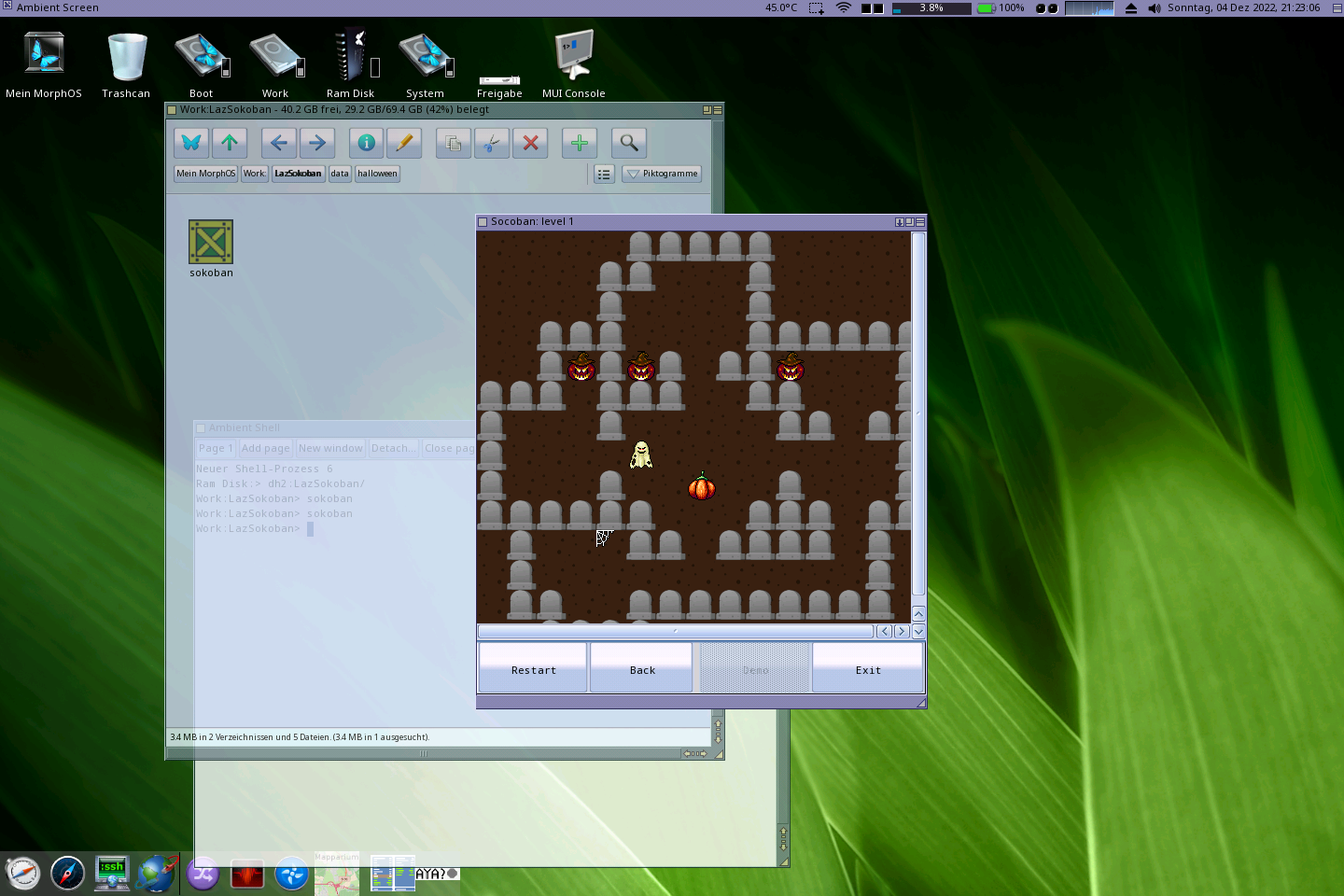
There was a miracle happened… I improved the LCL a bit after a long long time, investigated some unusual behavior at MorphOS with LazSokoban, especially because it was slower as expected. I found the culprit and recompiled the MorphOS binary, so have fun testing it.
Also, I did compile for OS4 but I did not not try it, seems I should have because the EXE does not work, at all, also no error message or so, I’m not sure what goes wrong there. It seems it happens when I try to compile a program from Lazarus for OS4 that the program does not work, but when I compile it in the command line it seems work. Interestingly the command line one is much bigger (for LazSokoban it’s double size) so that should be the reason, but I’m not sure whats the culprit. Needs investigation.
Someone asked if EdiSyn could be compiled for AmigaOS4 and yes I tried to compile it but the Executable crashes. I also tried to compile EdiSyn to compile for AmigaOS3 68k and on my new PiStorm Emu68 it works, but I would say it’s still a bit to slow to really use it.. the LCL is too thick of a layer for 68k
As I wrote before the PiStorm is already very nice, stable but not that fast, I heard with the Emu68 it should be much faster (not so much features though, not network, AHI direct access and so on).
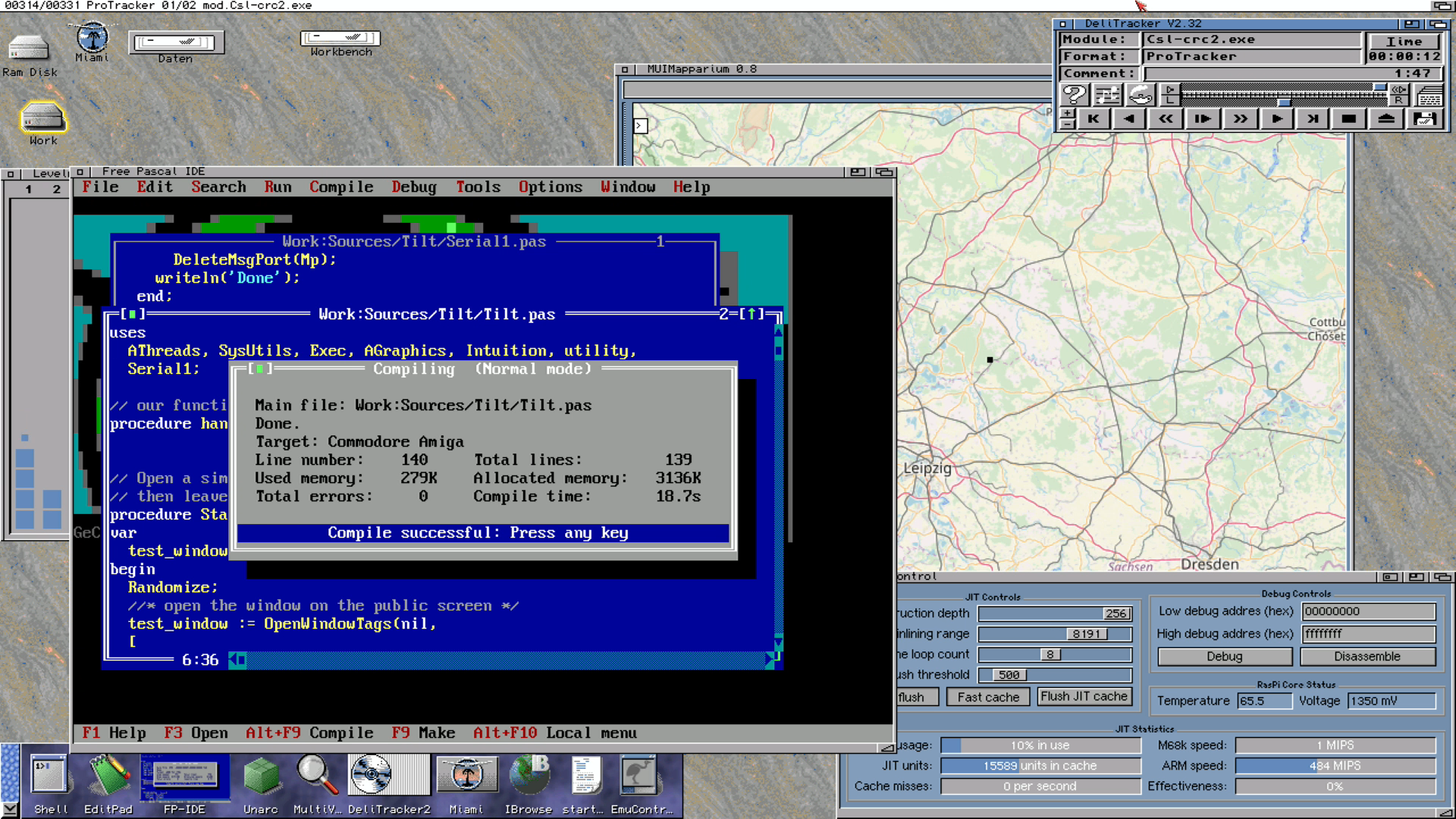
I used this manual. Also attached a cooler to the raspi to not let it overheat anymore and it works nicely barely it stays under 70° degree even on whole day use.
You can feel that it is much faster… SysInfo tells you that it is much faster, but to be honest, I never trusted SysInfo so lets get out my old test codes. Sadly the links to the benchmark game are gone, seems the page does not exist anymore, but I still have the sources so still can plan around with 🙂
Especially the tests: fannkuch 10 and BinaryTree 15. (68060/50Mhz= A1200 with Blizzard 1260, MorphOS = MacMini 1.4Ghz, UAE/AROS/Linux = Athlon FX 8120 3.16 Ghz)
machine
BinaryTree
fannkuch
Time [s]
Speed rel. to 060
Time [s]
Speed rel. to 060
68060/50Mhz
42.9
1.0
59.6
1.0
VampireA600
23.4
1.8
28.3
2.1
PiStorm A600 Emu68
11.4
3.8
11.9
5.0
MorphOS 68k emul
3.0
14.3
33.0
1.3
WinUAE OS3.9
1.4
30.6
2.0
29.8
MorphOS PPC
1.3
33
2.3
25.9
AROS i386
0.6
71.5
0.7
85.1
Linux x86_64
0.3
143
0.2
298
4-5 times of a 68060/50, not bad, it also emulates a FPU (68040) so also FPU tests are possible, for example the scimark test:
Amiga1200 68060/50 FPU code
Mininum running time = 2.00 seconds
Composite Score MFlops:     2.26
FFT             Mflops:     1.18    (N=1024)
SOR             Mflops:     5.05    (100 x 100)
MonteCarlo:     Mflops:     0.86
Sparse matmult  Mflops:     1.81    (N=1000, nz=5000)
LU              Mflops:     2.41    (M=100, N=100)

now for the PiStorm A600 Emu 68 it looks like this
Mininum running time = 2.00 seconds
Composite Score MFlops:    20.35
FFT             Mflops:    13.12    (N=1024)
SOR             Mflops:    41.80    (100 x 100)
MonteCarlo:     Mflops:     6.61
Sparse matmult  Mflops:    18.16    (N=1000, nz=5000)
LU              Mflops:    22.07    (M=100, N=100)
so here we have around 10 times faster than the good old 68060/50.
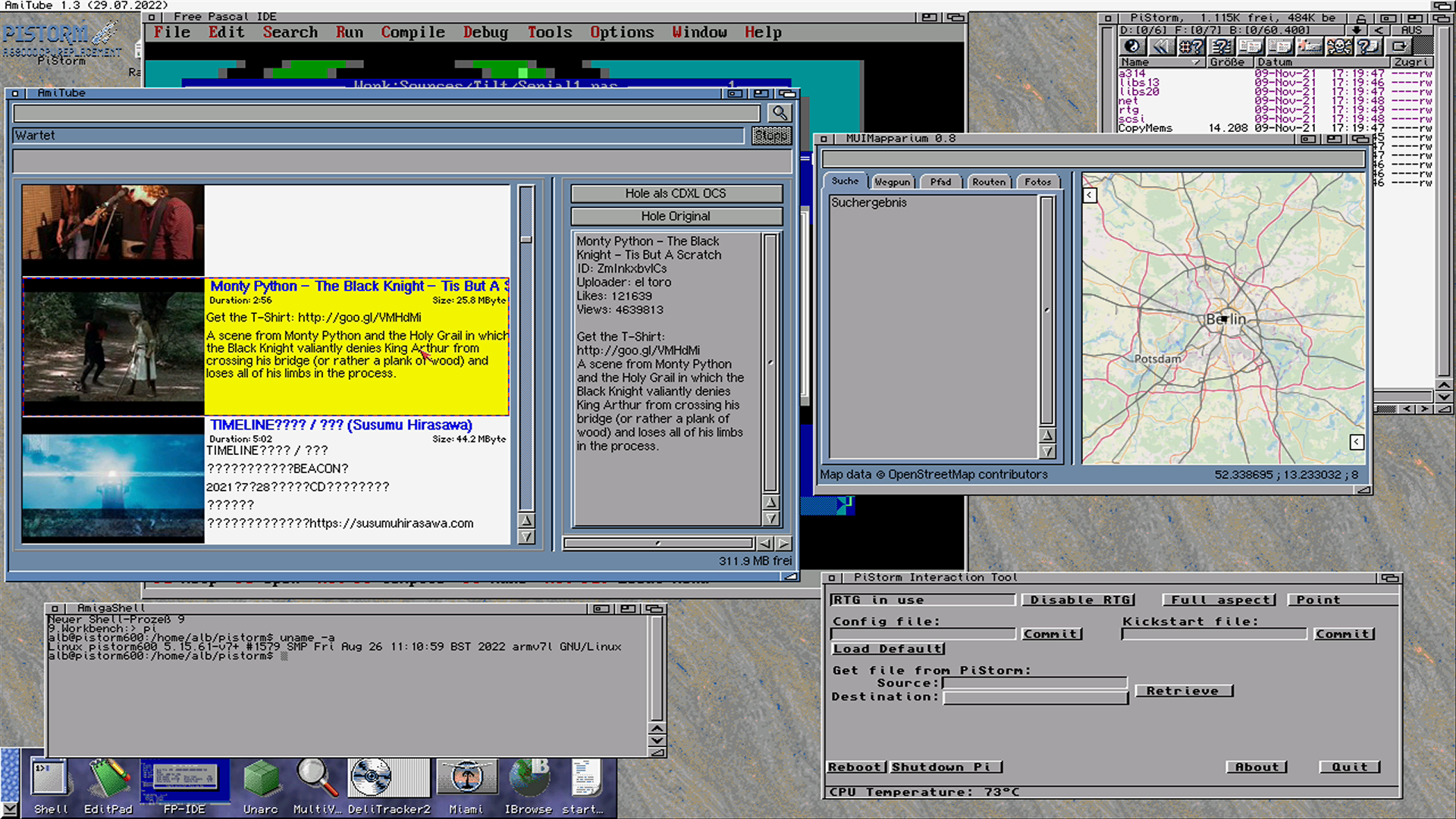
Here again it feels much faster because the RTG output is so smooth and the harddisk access is so much faster feels more like UAE speed wise. MUIMapparium for example is really nicely usable scrolls very smooth.
Also the Emu68 boots much faster than the other method and shows a nice boot picture, so you do not see the raspi booting just needs a bit longer than a usual Amiga boot (like you disconnected the Floppy).
And the most important… it seems to be stable same as the other method, some hours of Delitracker playing no crash, rebooting much more reliable than the other method… works always, I think I will stay with this Emu68 for now.
A long time before when I was working on the LCL for AROS I tested out some 3rd Party LCL application code to compile for AROS with the newly created LCL. It worked quite nicely. On of them was LazSokoban a Sokoban clone written by a russian guy which worked nicely on AROS.
Some Texts in the GUI where in russian and I translated them to english for the AROS release, some I had forgotten or mistyped a bit. Now I got a request to fix that problem, first there was the big problem to find such and old source code, but luckily it’s included in the archive I published (it’s GPL2, so I had to 😉 ) but I also found in on my Harddisk in the backup.
The changes where not to difficult to make, but the curious thing was if it would still work with the latest LCL. One thing I remember that I need to add the AThreads unit (like Linux CThreads) to make any LCL application work, back in the days that was not needed. And it still works, I checked out the original source and I noticed that they added some kind of skin system (different graphics for the tiles) and also supplied some which looks much nicer than the original one. So I added that as well the the AROS system, it will be available on the next Version of AROS One or here on my page of course.
The other thing that changed since then, we can now compile for MorphOS and OS4 as well (and for Amiga68k, but it will be much to slow for that, I tried) and it also seems to work, not everything, the Buttons images are missing but as far as the game goes not too bad. So I created a Version for all 3 Platforms, AROS, MorphOS and AmigaOS4
For quite a long time I have a Vampire V2 in my Amiga600, to be honest I never was really satisfied with it. The main purpose was to give RTG to a transportable Amiga and this was back in the days the only reasonable option (besides the BVision card for A1200 with PPC which is way too seldom and expensive). But sadly the Vampire V2 never worked really well, regularly it crashed even after a complete overhaul of the fitting and grounding and so on. Sometimes it wont boot sometimes it will just crash after some minutes. I often let my Amigas play mods with Delitracker, and if that specific Amiga is not able to do that for 2 hours straight (even better whole day of course) without crashing it’s just useless to me. My A1200 with Blizzard 1260/1230 and now TF1260 is perfectly able to do that all day long. My Draco is a bit difficult in that matter. Sometimes it runs a whole day without problems other times it crashes 2 times in a row in an hour. (I guess some AHI problems, because there are also other sound related issues).
But the A600 with the Vampire, that was a complete different story, it never managed to do a half hour Delitracker playing without crashing. After the card and Amiga600 was completely redone, better grounding, some stuff on the Vampire exchanged (or added?) i had the feeling it became a bit better, but just a bit. Still it never managed to make even 2 hours playtime without crashing. That was the main reason the Amiga600 with the Vampire V2 was never used and finally end up in a pile of stuff in the cellar.
Some weeks before I read some interesting articles about PiStorm and that there is a PiStorm hardware to connect a RaspberryPi to an Amiga600 (PiStorm600). I thought that would be a good chance to revive that poor Amiga600, so I took some garlic, a cross and went to the cellar to rescue the Computer.
Luckily I have a lot RasPis laying around (different Versions), bought them when they were cheap and easy to get 😉 sadly I don’t have a RasPi 3A but I have multiple RasPi 3B which should also work, just the USB port is in the way. I use a short extender cable to place the raspi a bit away from the adapter, therefore the additional USB port does not need to be removed. Until now I did not see and negative effects from the cable.
The software installation was quite easy, and after a little bit try and error I got finally the CF card to boot and to crash…. of course I need to de-vampirize the Workbench on there, which was not that difficult.
I bit difficult was the installation of RTG for some reason it did not work the first time I tried only got a nasty crash directly on bootup. Some days later I tried it again and this time it worked. I’m not sure what I did different but now it works. And this is the really good part. PiStorm shows the RTG screen on the HDMI output of the RasPi so you have a VERY clear and stable picture with for example 720p, (something I was never able to setup for the Vampire to work reliably)
It emulates a 68030 and 68881 in the RasPi. It’s not lighting fast or so, it’s around double speed of an 68030/50Mhz I would guess but the RTG is rather fast, so it feels much faster. But the usual Suspects work, so FreePascal and many of my programs, even MUIMapparium the FPU version works nicely.
Network seems to work, but it is rather slow, my PCMCIA card is much faster, but this is also described as still in development, so no surprises there.
Sound AHI via the HDMI from the Raspi, I never got to work, it seems it plays but I do not hear anything, maybe it’s still going to the headphone jack, I did not try. But this AHI is also not very important to me, for me the Amiga Chinch out is enough to play MODs.
And YES I tried it, let play Delitracker several hours random mods from the HD and it worked flawlessly not a single crash, very nice.
Of course it’s not all nice and shine, of course the Bootup needs rather long (around 30 s, it needs to Bootup the RasPi first) and for shutdown, you should shutdown the RasPi first before turning off the Amiga to prevent the sd-card in the Raspi to corrupt.
Also it seems at the moment it has some problems with the ROM mapping, if I use that Kickstart ROM and not the internal ROM, it has big problems rebooting the Amiga, usually it’s easier to shutdown everything and start fresh. Also the Bootmenu is somehow broken and mostly crash. All that do not happen if I use the internal hardware ROM.
At the moment the RasPi inside the Amiga case becomes rather hot and starts to clock down so I will need to a add a heat sink of some sort, but there should be enough space and I should think about additional power to the Raspi because it complains about undervoltage which also causes clocking down of the speed.
But overall not too bad and a good idea to emulate the 68k on the Raspi. I’m rather satisfied.